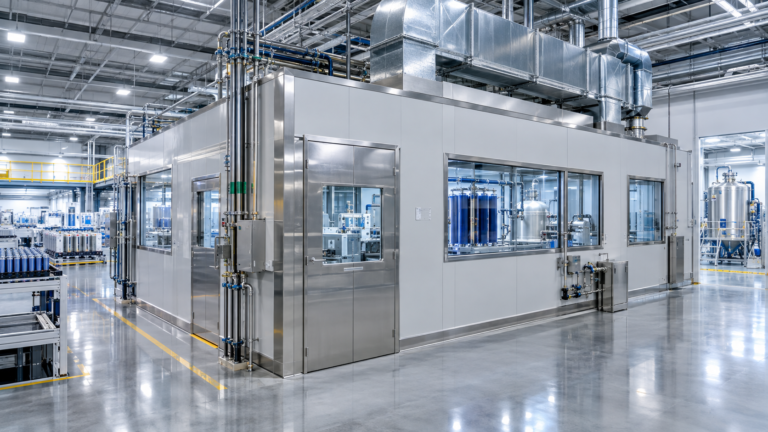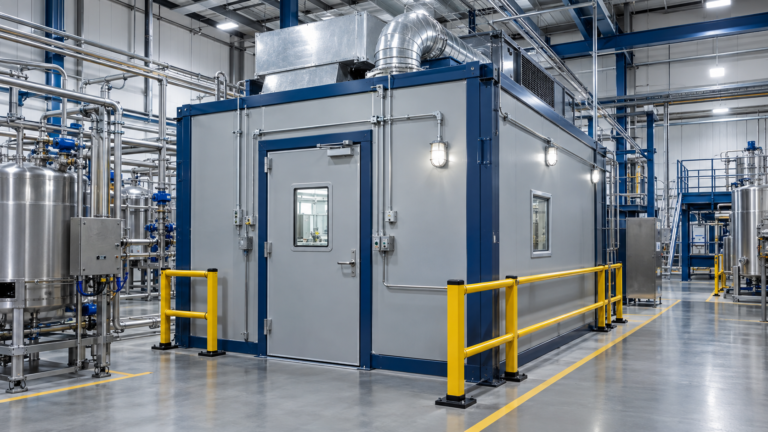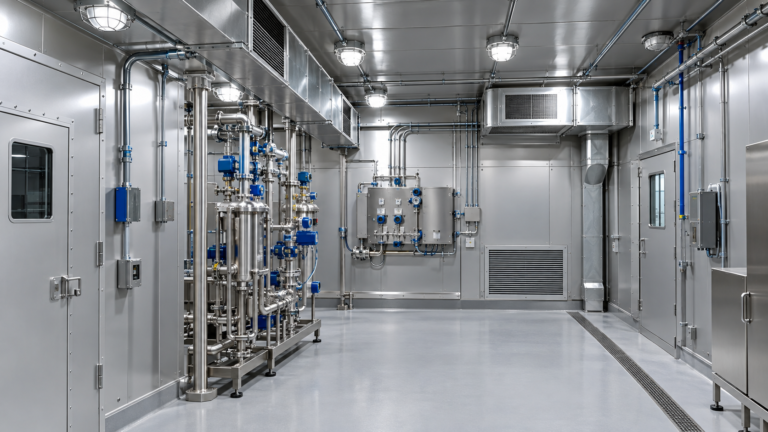
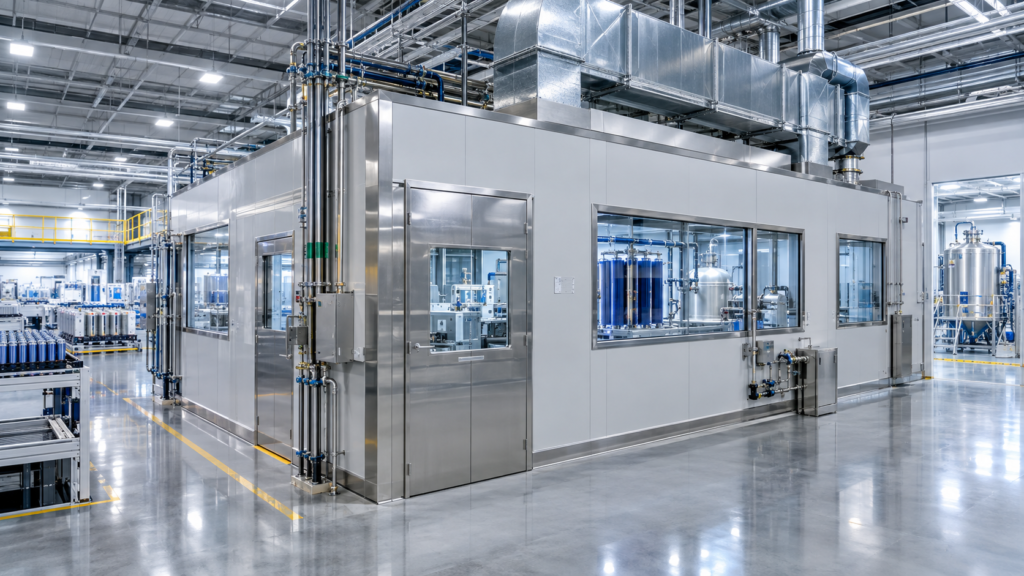
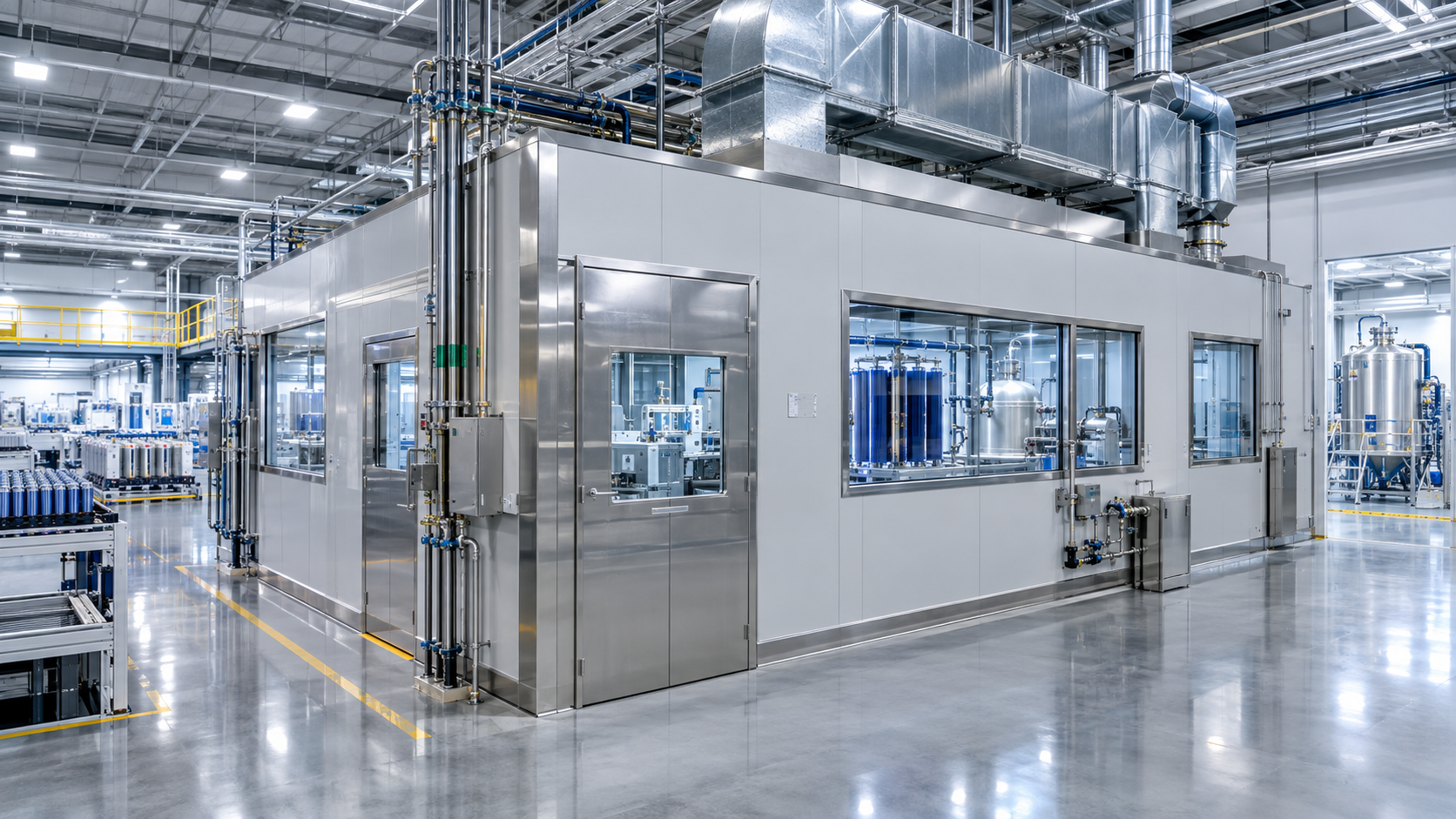
Modular high hazard rooms give battery manufacturers and superconductor fabricators a defined, engineered space for operations that require coordinated fire protection, ventilation, and hazardous-location electrical design. By planning the enclosure alongside the process and facility, teams can address critical interfaces earlier and prepare a scalable layout for future production needs.
Why modular high hazard rooms suit advanced manufacturing
Battery manufacturing and superconductor fabrication place different demands on a production environment, but both benefit from a clear design basis. A modular high hazard room can create a defined process boundary, organize access and utility connections, and coordinate protective systems around the actual equipment. It is not a substitute for a project-specific hazard analysis: the materials, operating steps, credible release scenarios, and adjacent occupancies all shape the final design.
Start by mapping each process step and its interfaces with the wider plant. Identify where equipment, operators, maintenance access, material movement, ventilation, and emergency response must connect. This early coordination helps the design team distinguish the room’s scope from the safeguards that belong elsewhere in the facility.
Modular high hazard rooms in battery manufacturing
Lithium-ion cell production may include electrolyte handling, cell assembly, formation, and testing. These activities are not identical, so a single generic room specification is rarely a sound starting point. Project engineers should evaluate the materials and equipment at each station, potential ignition sources, ventilation needs, fire protection strategy, detection, and the route for safe shutdown.
For each area, the design basis should state what the enclosure is intended to do and what it is not intended to do. Fire-rated construction, suitable electrical components, monitored ventilation, and engineered pressure relief may be considered where the hazard analysis and applicable codes call for them. No single feature should be treated as a guarantee against a thermal event; protection depends on the complete, reviewed system and the facility’s response plan.
Because production lines evolve, modular high hazard rooms can also help separate a process zone from neighboring assembly or test areas. Documenting clear utility tie-ins and reserved expansion space makes later equipment changes easier to assess without assuming that a future change is automatically covered by the original approval.
Modular high hazard rooms for superconductor fabrication
Superconductor fabrication may involve controlled atmospheres, cryogenic equipment, and specialized process gases. These conditions call for careful planning of ventilation, gas detection, oxygen monitoring where an oxygen-deficient atmosphere is a credible concern, emergency isolation, alarms, and access. The appropriate safeguards depend on the specific process and materials rather than on the room label alone.
A modular enclosure can bring these systems together in a coordinated package, while keeping service routes and inspection points accessible. Designers should consider how a loss of power, ventilation interruption, equipment fault, or maintenance task changes the operating conditions. Clear alarm responses and integration with facility controls help operators understand when a process should be paused and how the area should be secured.
Modularity is especially useful when a fabrication program will expand in phases. A repeatable room footprint and planned connection points can support a measured increase in capacity, subject to review of new equipment loads, process hazards, utilities, and permitting requirements.
Engineering the fire, electrical, and ventilation basis
Electrical area classification should follow the conditions expected in each specific room or portion of a room. OSHA’s hazardous-location rule says each room, section, or area is considered individually and that electrical equipment and wiring must be suitable for the classified location. See OSHA 29 CFR 1910.307 for the federal requirements. Qualified professionals should document the classification basis and select equipment accordingly.
Ventilation engineering should account for the process, required air movement, exhaust discharge, make-up air, monitoring, and the response to a fault. Fire protection and any explosion-relief approach should be selected through the project’s hazard review, not copied from another installation. The design team should coordinate applicable NFPA standards, OSHA requirements, the locally adopted International Fire Code, building and electrical codes, and the authority having jurisdiction. Requirements vary by location and application, so early review is essential.
For an overview of one modular enclosure approach, see C1D1 Labs’ fire-rated processing booth information. Confirm the scope, listings, interfaces, and project-specific engineering before specifying a system.
Deploy modular high hazard rooms in stages
Prefabricating room components can move some assembly and coordination work away from a busy plant floor. With a complete design package, defined foundations, utility connections, and a permitting plan, this approach may shorten on-site installation compared with building every element in place. Actual schedules depend on engineering, procurement, inspections, and approval by the relevant authorities.
Scalability comes from planning for the next production step now: reserve space, coordinate utility capacity, define where future modules could connect, and keep egress and service access clear. Treat every expansion or process change as a change to be reviewed, including any new equipment, materials, or operating conditions. This discipline lets modular high hazard rooms support growth while preserving a documented safety basis.
For battery and superconductor projects, the strongest starting point is a joint review by process, facilities, fire-protection, electrical, and safety specialists. A purpose-built modular room can make that coordination visible and manageable—while keeping final design decisions tied to the real hazards, applicable codes, and local approval process.