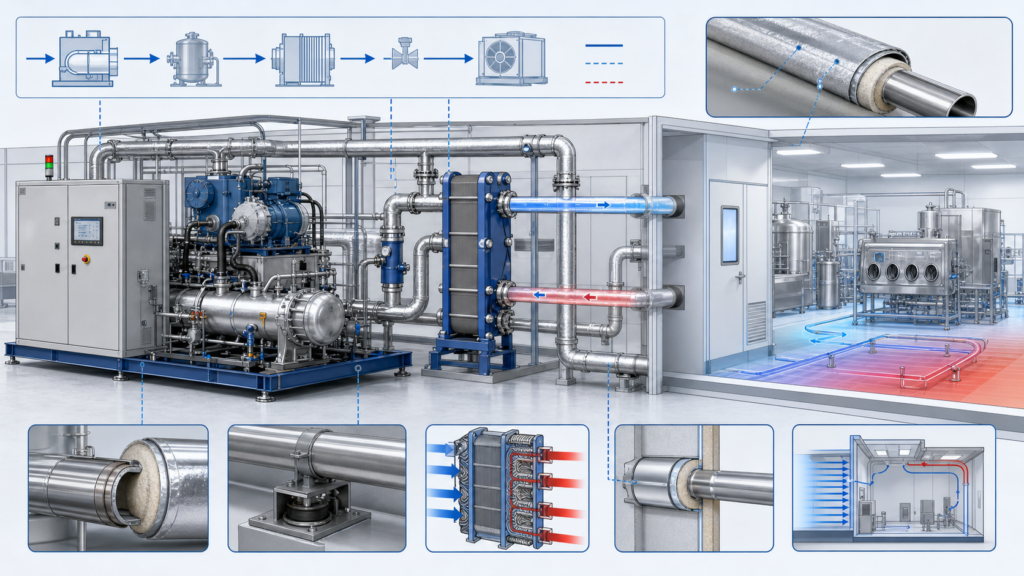
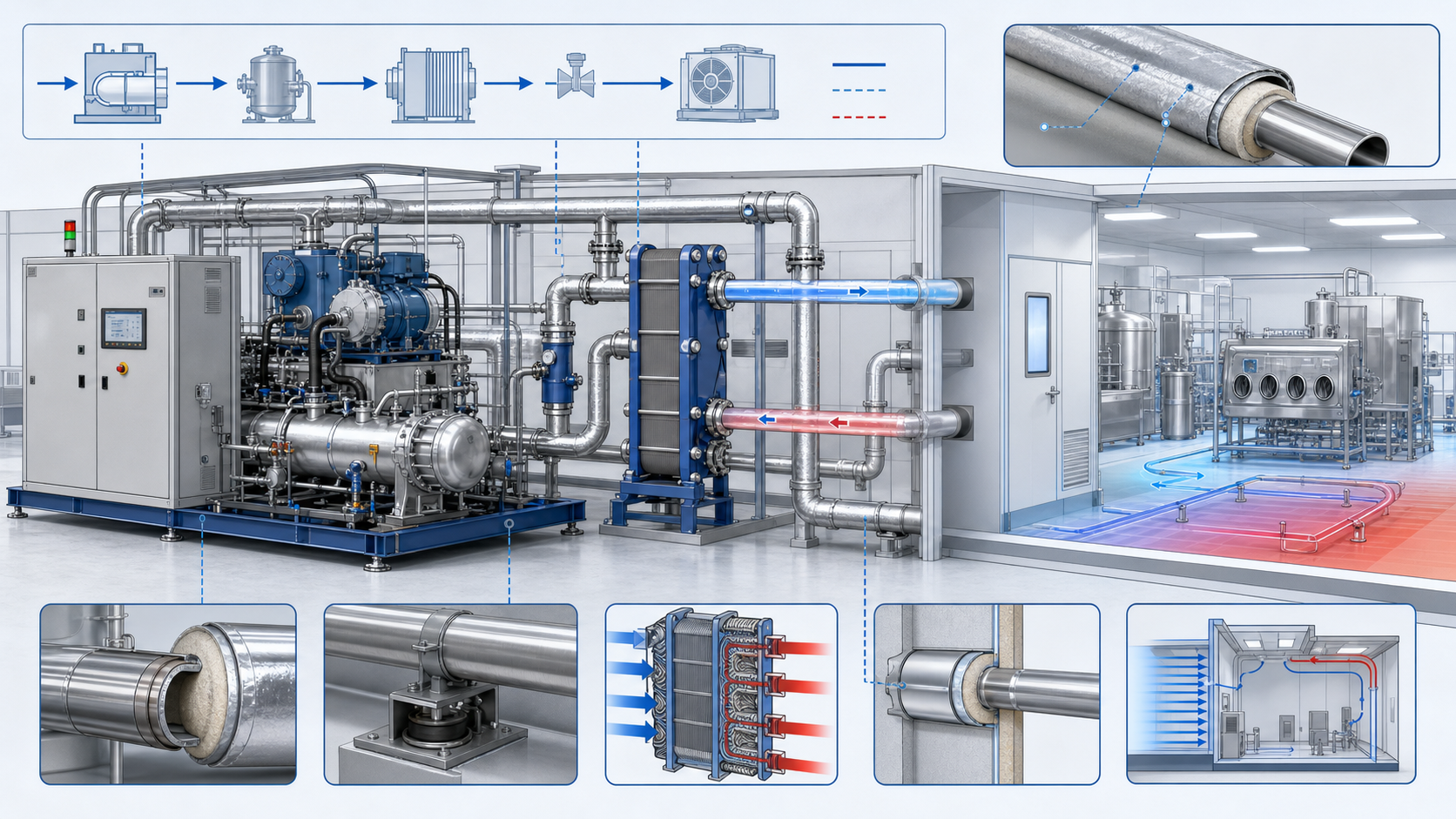
Cryogenic chiller design sets the foundation for stable low-temperature control, reliable equipment operation, and a safer industrial processing environment. When the cooling system is planned as part of the facility—not added after the process is finalized—owners can protect product quality while keeping maintenance, energy use, and compliance visible from the start.
Why a cryogenic chiller belongs in early planning
Very low temperatures affect more than the chiller itself. They influence insulation thickness, pipe routing, condensation management, electrical loads, access clearances, drainage, ventilation, and the location of sensors. Early coordination lets mechanical, electrical, and process teams agree on a practical equipment room, service path, and control strategy before construction limits the options.
Start with the process temperature range, ramp-up and pull-down targets, operating hours, and acceptable variation. A clear design basis helps the engineer size the system for real demand instead of a single idealized setpoint.
Build the cryogenic chiller load profile
Cooling capacity should reflect the complete thermal picture. Document the heat entering through room surfaces, doors, vessels, piping, pumps, motors, lighting, and personnel. Include the initial cooldown of equipment as well as the steady-state load. If batches, cleaning cycles, or seasonal ambient conditions change demand, model those operating cases separately.
- Define minimum, normal, and peak cooling demand.
- Record supply and return temperatures, flow rates, and allowable approach temperatures.
- Confirm whether redundancy, standby capacity, or a staged system is needed.
- Set alarm limits for temperature drift, flow loss, pressure changes, and loss of insulation performance.
This information gives the cryogenic chiller supplier a defensible basis for selection and gives the owner a useful benchmark for commissioning.
Cryogenic chiller system architecture and materials
A complete package may include the refrigeration circuit, heat exchanger, circulation pumps, insulated distribution piping, valves, instrumentation, and a control panel. Specify materials and joint details for the lowest operating temperature, expected thermal cycling, and cleaning requirements. Pay particular attention to supports: cold piping contracts, and poorly detailed anchors can transfer stress into equipment nozzles or building penetrations.
Insulation is a performance and reliability item, not a cosmetic finish. Continuous vapor barriers, sealed terminations, protected cladding, and accessible inspection points help prevent condensation and preserve efficiency. Coordinate penetrations with the room envelope so the cooling system does not create avoidable moisture paths.
Controls and safety for cryogenic chiller operation
Controls should make normal operation simple and abnormal conditions obvious. Use independent temperature and flow verification where a single failed sensor could hide a damaging condition. Place emergency stops, local disconnects, and service access where technicians can reach them without crossing congested process areas. Review ventilation, oxygen-deficiency monitoring where applicable, pressure relief routing, and emergency response procedures with the project safety team.
For adjacent low-temperature storage or freezer needs, see C1D1 Labs’ low-temperature and explosion-proof freezer solutions. Also review OSHA’s compressed gas requirements and involve the authority having jurisdiction early.
Specify a cryogenic chiller for lifecycle value
A strong specification covers more than nameplate capacity. Ask for documented performance at design conditions, utility requirements, sound levels, service clearances, spare-parts support, controls integration, factory testing, field startup, and operator training. Require drawings that show weights, connection points, heat rejection, and maintenance access so the building team can validate the installation.
During commissioning, verify sensor calibration, flow balance, pull-down time, alarm sequences, interlocks, and operation at representative loads. Capture baseline temperatures and energy data for future troubleshooting. Establish a preventive-maintenance schedule for filters, seals, pumps, valves, sensors, and insulation inspections, then assign clear ownership for alarm review and spare-parts replenishment. With a coordinated design basis and disciplined startup, a cryogenic chiller can deliver repeatable low-temperature control without becoming a hidden source of downtime.