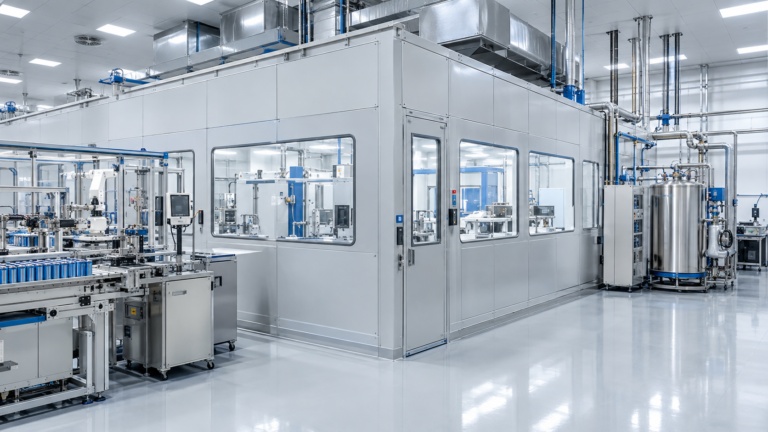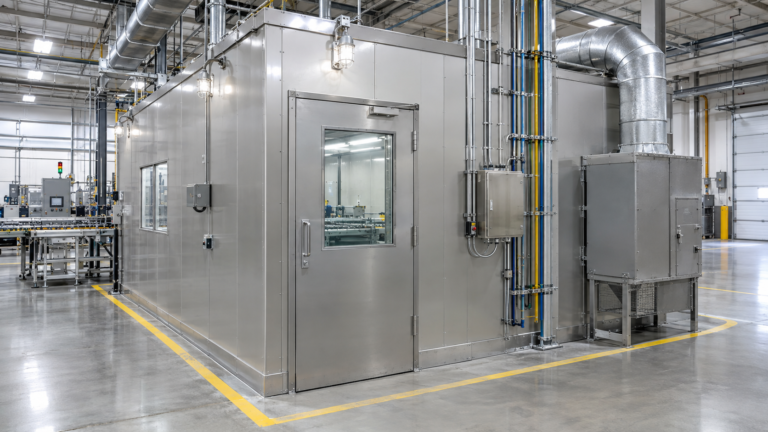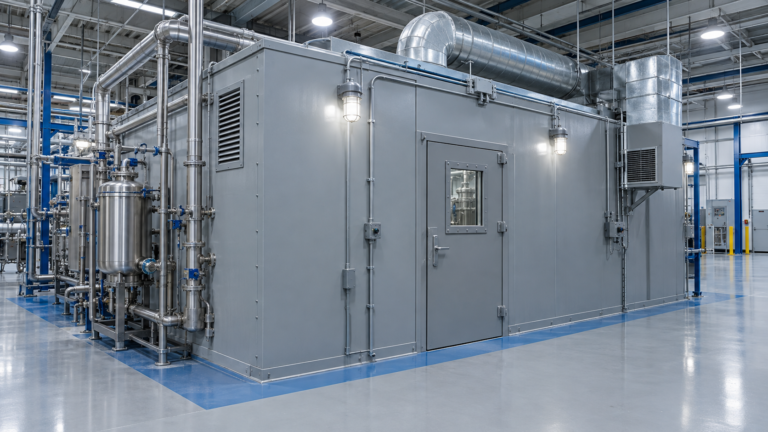
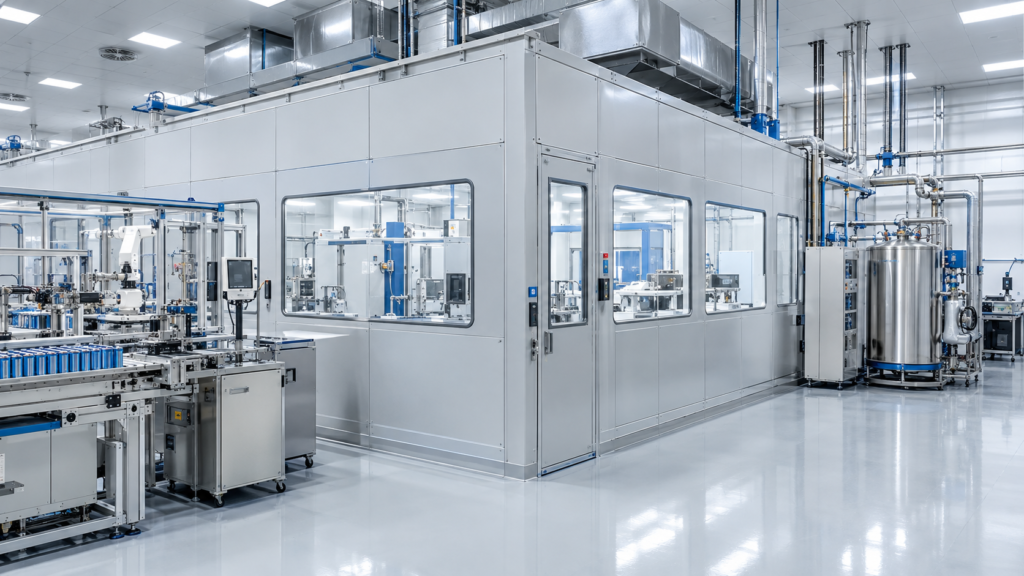
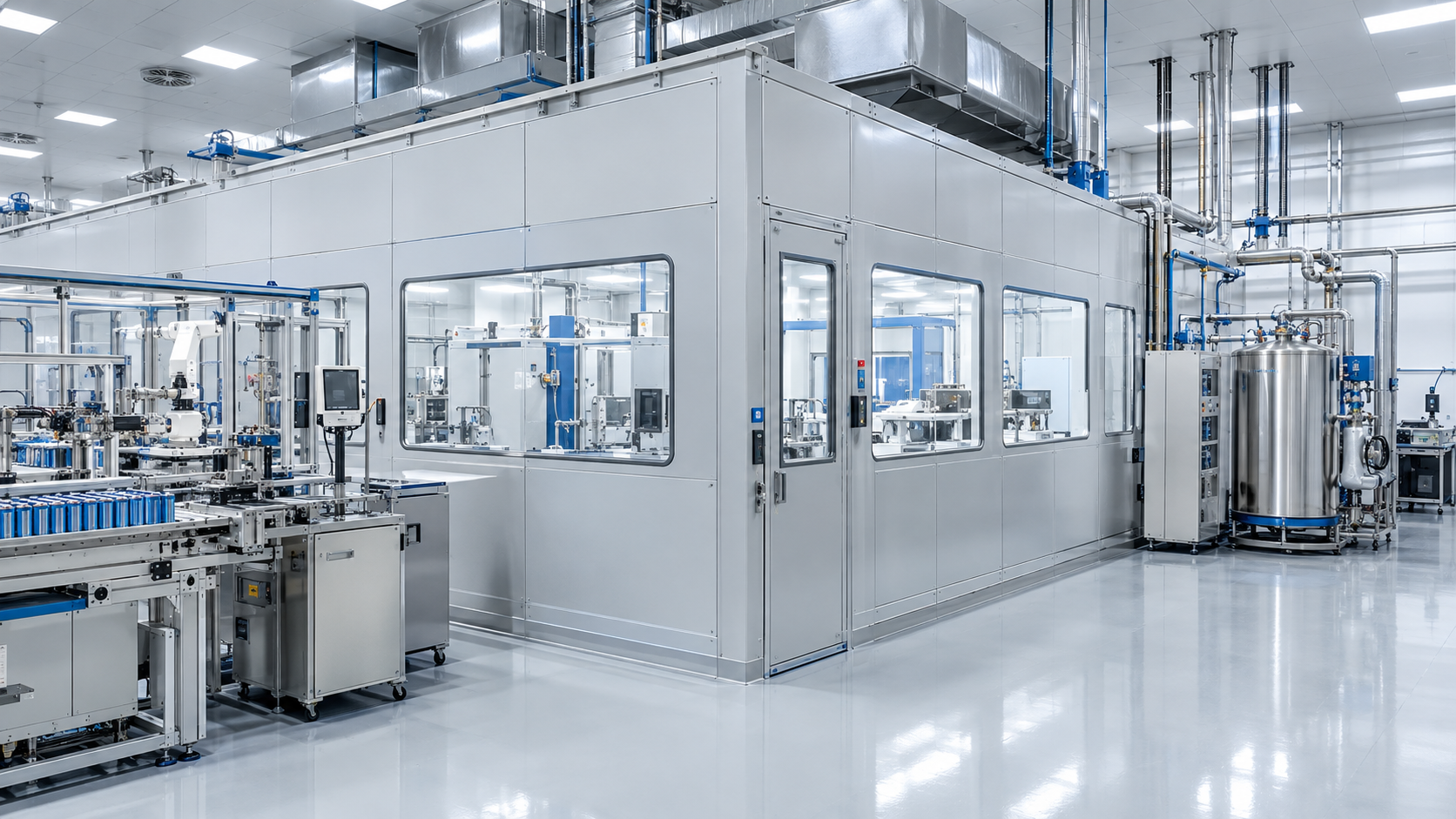
Modular high hazard rooms help battery manufacturers and superconductor fabricators plan a defined work area around process-specific risks, facility interfaces, and code review. Rather than treating an enclosure as a stand-alone box, project teams can coordinate the room with equipment, ventilation, fire protection, electrical systems, access, and emergency procedures before installation begins.
Why modular high hazard rooms suit advanced manufacturing
Battery cell production and superconductor fabrication can involve specialized materials, tightly controlled environments, complex utilities, and demanding production schedules. A modular approach allows much of the room design and fabrication to happen before delivery, while the project team coordinates the enclosure with the host building. That can reduce the amount of field work and help make installation milestones easier to plan.
Modular high hazard rooms can also support a phased growth strategy. A manufacturer can define the first production area, identify the interfaces needed for future lines, and plan whether additional rooms or capacity may be added later. This is not a substitute for engineering review: each phase still needs to be evaluated for its actual process, inventory, equipment, and site conditions.
Plan modular high hazard rooms from the process assessment
Before selecting a room size or rating, document what takes place inside it. Record the materials and quantities involved, how they are received and transferred, the steps where a release could occur, the equipment used, and the people who need routine or emergency access. For battery manufacturing, project teams should evaluate cell chemistry, electrolyte handling, stored energy, and credible abnormal conditions. For superconductor fabrication, a process may require attention to cryogenic service, inert atmospheres, specialty gases, or other tightly controlled conditions.
These are design inputs, not a universal checklist of required features. The hazard assessment should determine which controls apply and how they interact. Modular high hazard rooms are most useful when process engineers, facility owners, fire-protection professionals, electrical designers, and operations staff agree on those inputs early.
Coordinate enclosure, ventilation, and electrical design
Room boundaries, doors, penetrations, ductwork, utility routing, and equipment placement should be coordinated as one system. Ventilation design should follow the process assessment and account for the intended operating conditions, monitoring strategy, and response to equipment faults. If the process calls for inert or cryogenic conditions, those needs must be reconciled with ventilation, personnel safety, alarms, and the facility’s emergency plan.
Electrical classification is also site- and process-specific. OSHA’s hazardous-location rule says each room, section, or area is considered individually, and that electrical equipment and wiring in classified locations must be suitable for that location. Teams can use OSHA’s requirements for hazardous classified locations as a starting point for coordinating classification documentation and equipment selection with qualified professionals and the authority having jurisdiction.
Plan fire protection and emergency response together
Fire-resistance, detection, suppression, isolation, gas monitoring, and emergency shutdown features should be selected from the project’s hazards and applicable codes, not copied from another facility. Battery operations may require a documented response strategy for abnormal cell or process events. Superconductor work may introduce different response considerations related to process conditions and specialized utilities. Room design should preserve safe egress, service access, and clear interfaces with building systems.
A well-coordinated design identifies who owns each function: the room supplier, building engineer, equipment vendor, installer, fire-protection contractor, and facility operator. This helps reveal gaps before procurement and gives reviewers a clearer package to evaluate. No modular enclosure alone guarantees approval; final requirements depend on the adopted codes, project documents, and local review.
Make modular high hazard rooms easier to deploy
Early coordination can turn a complex room into a manageable project sequence: define the process, complete the hazard and code review, freeze interfaces, fabricate the module, prepare the site, then install and commission the integrated systems. Standardized interfaces can support repeatability across production lines, while room-by-room engineering preserves flexibility where processes differ.
For manufacturers evaluating fire-rated modular enclosures, C1D1 Labs’ high-hazard room overview describes configurable room approaches for integration into existing industrial facilities. The right scope depends on the materials, quantities, equipment, protection objectives, and jurisdictional requirements for the project. Discussing those details early helps the design team develop a practical path from concept through installation.