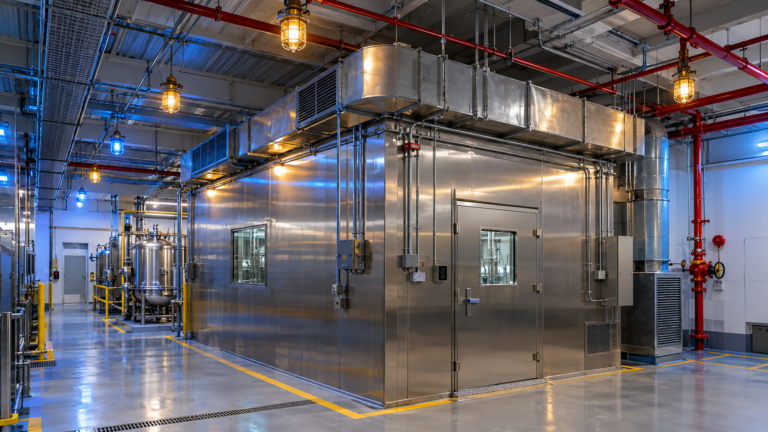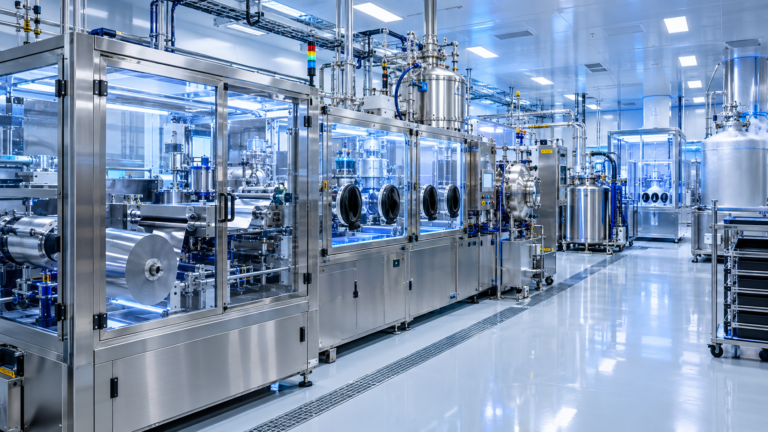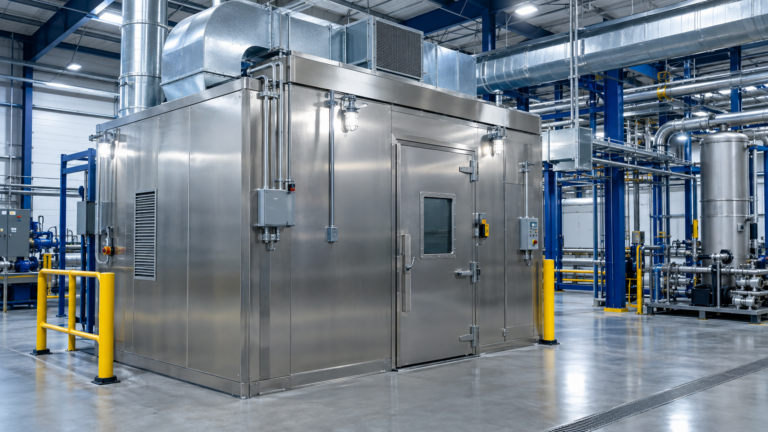
Modular high hazard rooms help battery manufacturing and superconductor fabrication teams isolate demanding process steps while keeping fire protection, utilities, and expansion plans coordinated. A prefabricated enclosure can bring controlled ventilation, hazardous electrical classification, monitoring, and documented building interfaces into one engineered package.
Why modular high hazard rooms fit advanced manufacturing
Battery plants may manage electrolyte systems, energized cells, dry-room environments, and equipment with significant stored energy. Superconductor fabrication can involve cryogenic service, inert environments, specialized gases, vacuum equipment, and strict contamination controls. These operations have different process profiles, but both benefit from a defined room boundary that makes hazards easier to separate, monitor, maintain, and review.
Modular high hazard rooms are designed around the process rather than treated as generic partitions. The project team can establish the footprint, access points, equipment clearances, service zones, and inspection paths before fabrication. That early definition helps the facility coordinate the enclosure with production flow, emergency response, maintenance access, and future equipment changes.
How modular high hazard rooms manage fire and explosion risk
A high-hazard room starts with a documented hazard analysis. Designers evaluate materials, inventories, operating temperatures, credible release scenarios, ignition sources, pressure effects, and the people who may enter the space. In battery manufacturing, the design may address thermal-runaway propagation, electrolyte vapor, charging operations, and safe separation of energy-storage equipment. In superconductor fabrication, it may address cryogenic releases, oxygen-deficiency concerns, inert-gas service, and specialized process utilities.
From that analysis, the enclosure can incorporate rated construction, controlled air movement, gas or oxygen monitoring, fire detection, suppression interfaces, pressure-relief strategies, and emergency shutdown logic. The exact features depend on the process and the adopted codes. A modular room does not replace engineering judgment; it creates a repeatable platform for applying that judgment and recording the resulting performance requirements.
Electrical classification and ventilation for modular high hazard rooms
Electrical equipment must match the classified area and the conditions identified in the design basis. Modular high hazard rooms can be specified with appropriately rated lighting, controls, motors, sensors, junction boxes, and wiring methods. Where battery operations can create a combustible atmosphere, the electrical design should be coordinated with ventilation, detection, grounding, and shutdown functions. In cryogenic or inert environments, monitoring and alarm strategies should also account for oxygen displacement and restricted visibility.
Ventilation is equally important. Engineers can establish make-up air, exhaust paths, pressure relationships, capture points, filtration, and discharge locations around the actual process. Interlocks can prevent start-up when airflow or monitoring is unavailable, while alarms can give operators clear direction during an abnormal condition. Qualified professionals should verify the final design against applicable NFPA, OSHA, IFC, NEC, fire-code, and local requirements. The lithium-ion battery overview provides useful background on why cell chemistry and energy density matter to facility planning.
Faster deployment and scalable capacity
Prefabrication shifts many construction activities into a controlled shop environment. Panels, doors, viewing windows, cable pathways, ventilation connections, and equipment supports can be assembled and checked before the room reaches the site. That approach can reduce field disruption, shorten installation windows, and make quality records easier to organize. It also gives the owner a clearer package for coordination with the authority having jurisdiction and the facility’s commissioning team.
For a growing plant, modular construction supports staged capacity. A facility can begin with a room sized for a pilot line, then add compatible modules or reconfigure service connections as production evolves. This is useful when battery products, superconductor programs, or process equipment are moving through development cycles and the final layout may change. The enclosure becomes an adaptable part of the facility strategy rather than a permanent constraint on production.
Planning a compliant modular high hazard room
Successful projects connect the room to the building and operating procedures from the start. The design team should document:
- Process hazards: materials, inventories, temperatures, pressures, energy sources, and credible failure modes.
- Protection criteria: fire ratings, detection, suppression, relief, monitoring, ventilation, and emergency shutdown.
- Facility interfaces: structural support, utilities, exhaust routing, drainage, egress, access control, and maintenance clearance.
- Verification records: equipment ratings, drawings, test results, commissioning steps, training, and change-control requirements.
For an example of how a prefabricated enclosure can support a code-conscious industrial project, review C1D1 Labs’ fire-rated processing booth resource. With the process basis, code review, and facility interfaces aligned early, modular high hazard rooms can help advanced manufacturers deploy safer capacity with less rework.