When designing high-capacity industrial processing facilities, the management of hazardous atmospheres is arguably the most critical engineering concern. C1D1 (Class I, Division 1) hazardous locations, as defined by the National Electrical Code (NEC) and governed by the National Fire Protection Association (NFPA), demand stringent controls to prevent the accumulation of flammable vapors.
Whether the facility employs hydrocarbon or ethanol processing processes, establishing an effective airflow strategy relies not just on volume, but on velocity, distribution, and fail-safe integration. Below is an examination of essential principles for maintaining a safe and compliant working environment.
The Mandate for Exhaust Continuity
The foremost objective in any C1D1 processing booth or room is diluting and safely removing explosive gases before they reach the Lower Flammable Limit (LFL) or Lower Explosive Limit (LEL). According to NFPA 30 (Flammable and Combustible Liquids Code), reliable continuous ventilation is a baseline requirement. Facilities processing substantial volumes must engineer their systems to treat “worst-case” leak scenarios.

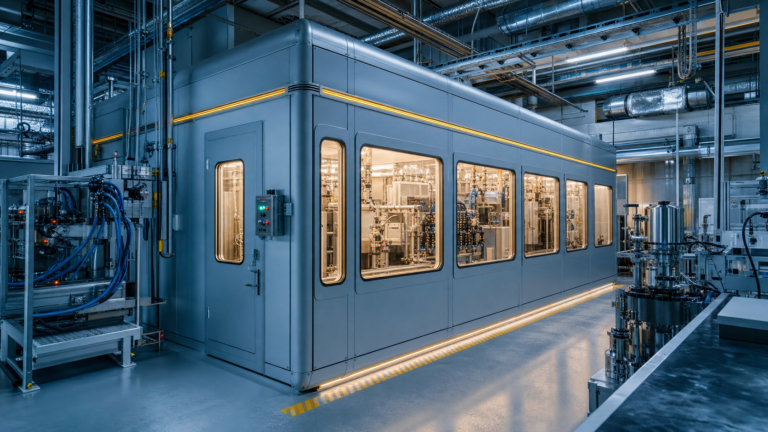
Proper mechanical ventilation ensures explosive vapors never reach a hazardous concentration.
Air exchange rates (AER) often specified merely as CFM per square foot of floor area provide a starting point. However, advanced fire protection engineering dictates looking closely at local exhaust ventilation (LEV). Compounding heavy vapors—like butane and propane, which sink—requires low-level intakes strategically positioned near potential leak sources. Conversely, ethanol vapors, while also typically heavier than air, behave differently under the thermal dynamics of specific processing equipment and must be evaluated accordingly.
Interlocks and Emergency Processing Control
A compliant industrial processing room design must include automated interlocks tying the mechanical ventilation rates directly to gas detection sensors. Building and fire codes heavily reference the International Fire Code (IFC) for establishing hazardous materials handling procedures. A core requirement is that upon detecting an unsafe LEL threshold (often configured at 10% or 20%), the facility’s control systems immediately take remedial action.
This action is two-fold:
- Equipment Shut-Off: Solenoid valves or electronic controls interrupt the flow of solvents and halt processing equipment operations.
- High-Speed Purge: The exhaust fans ramp up from operational speed to purge or emergency exhaust speed, forcing rapid air turnover to clear the hazardous atmosphere.
Integrating these functions smoothly is a hallmark of premium C1D1 booths, where explosion-proof (EX) rated motors and intrinsic safety barriers provide operational certainty during anomalous conditions.
Makeup Air and Positive Pressure Dynamics
You cannot exhaust large volumes of air without simultaneously introducing an equivalent volume of fresh makeup air (MUA). An processing facility must be precisely balanced. If a room goes too negative relative to its surroundings, doors can become impossible to open, creating severe life safety egress concerns violating the International Building Code (IBC).
Furthermore, an extreme negative pressure environment could draw contaminants or untrained personnel inward when doors are breached. Standard practice in complex facility design involves slightly negative pressure within the hazardous room relative to adjacent corridors, ensuring any escaping vapor flows into the hazard zone rather than out of it, combined with robust MUA units interlocked with the exhaust fans to maintain equilibrium.
Filtration and Environmental Compliance
Beyond safety, environmental compliance heavily dictates exhaust design. Local municipalities often mandate that vented processing exhaust be filtered to remove volatile organic compounds (VOCs) and particulate matter prior to atmospheric discharge. Scrubbers and specialized carbon filtration media are regularly specified by the Authority Having Jurisdiction (AHJ) as part of the facility permitting process.

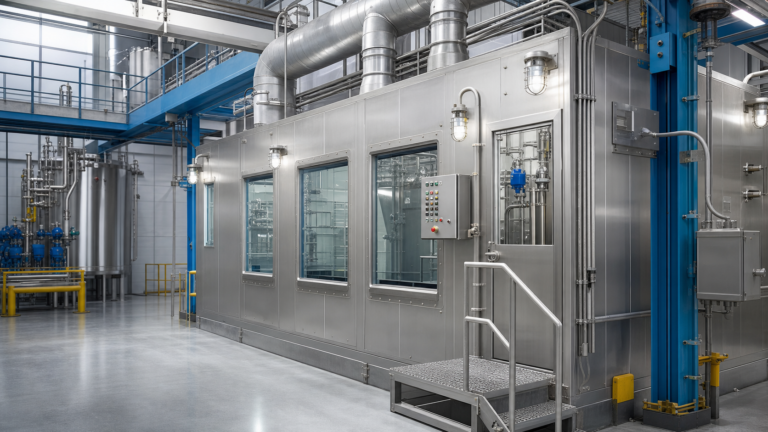
Environmental scrubbers remove process vapors before external venting occurs.
Integrating these filters introduces static pressure into the exhaust ducting network. Fan sizing must mathematically account for this static pressure drop to ensure the intended CFM actually reaches the processing room floor. If an engineer neglects this step during code-driven facility planning, the system will underperform at commissioning.
Strategic Layout and Duct Routeing
The physical routing of ducts can either support or hinder airflow efficiency. Long, serpentine duct runs generate significant friction loss. In optimal setups, the fan units are situated as closely as practically feasible to the discharge point—often the roof. Maintaining relatively straight runs with smooth-walled, non-combustible ducting mitigates turbulence, optimizing volumetric efficiency.
In addition, clear access hatches for inspection and cleaning are necessary to prevent hazardous dust or oil film accumulation within the system over time. Both fire protection engineering protocols and localized building codes address the required clearances and materials suitable for exhausting hazardous solvent gases.
Conclusion
A sophisticated industrial processing operation requires more than rudimentary exhaust fans. Optimizing airflow in a C1D1 hazardous location requires coordinating low-level intakes, LEL detection interlocks, makeup air balancing, and environmental filtration. By adhering strictly to the standards established by NFPA, IFC, and IBC, facility managers ensure their high-capacity laboratories remain fundamentally safe and structurally compliant under all processing conditions.