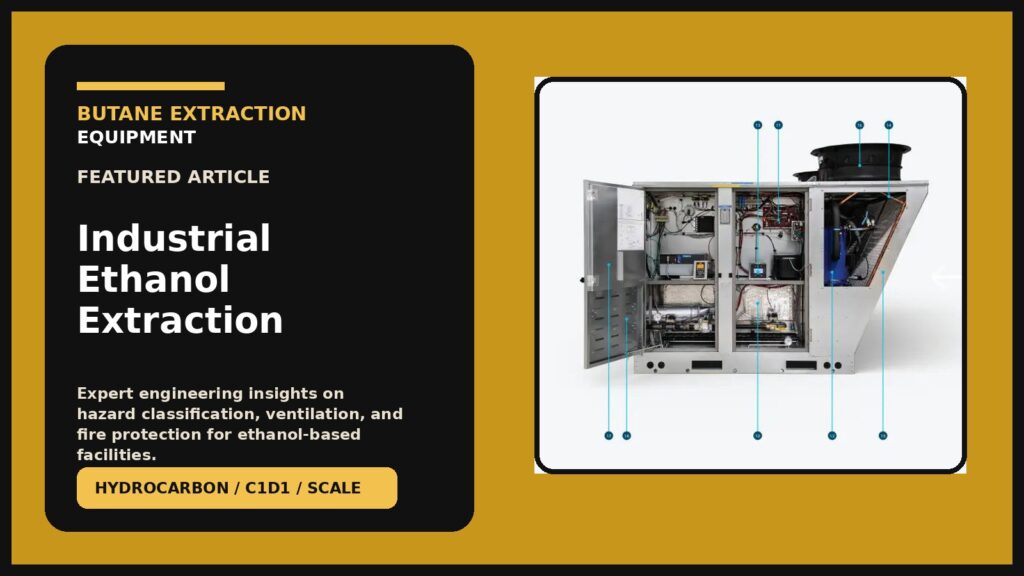
When scaling a commercial processing facility, configuring an industrial ethanol extraction room requires precise adherence to fire and building codes. Because ethanol is a flammable liquid, any extraction and refinement processes using it demand specialized engineering and life safety systems to protect personnel and property. Modern facility planning must integrate compliance at the earliest stages of equipment selection and architectural layout to ensure the resulting infrastructure is both safe and permitted for industrial use.
At the center of compliant facility design are the standards published by the International Code Council (ICC) and the National Fire Protection Association (NFPA). Proper implementation of the International Building Code (IBC) and International Fire Code (IFC) dictates occupancy classifications, separation requirements, and necessary safeguards that form the backbone of a professional extraction lab environment.
Hazard Classifications and Occupancy Separation
The first critical step in ethanol extraction room planning is accurately defining the hazardous classification. The amount of ethanol—typically categorized as a Class IB or IC flammable liquid—stored and processed determines whether a facility must be classified as a Group H (High-Hazard) occupancy. The International Fire Code (IFC) establishes Maximum Allowable Quantities (MAQs) for flammable liquids based on the occupancy type and floor level. When processing volumes exceed these limits, specialized H-3 or H-2 room requirements apply, necessitating specific fire-resistance-rated separations from adjacent spaces.
Control areas can sometimes be utilized to manage inventory effectively within non-high-hazard occupancies, but as production scaling demands larger solvent reservoirs and faster throughput, the integration of dedicated C1D1 or C1D2 booths and properly rated isolation enclosures becomes crucial. These enclosures are engineered to contain potential incidents and provide a secondary layer of protection for the rest of the facility.

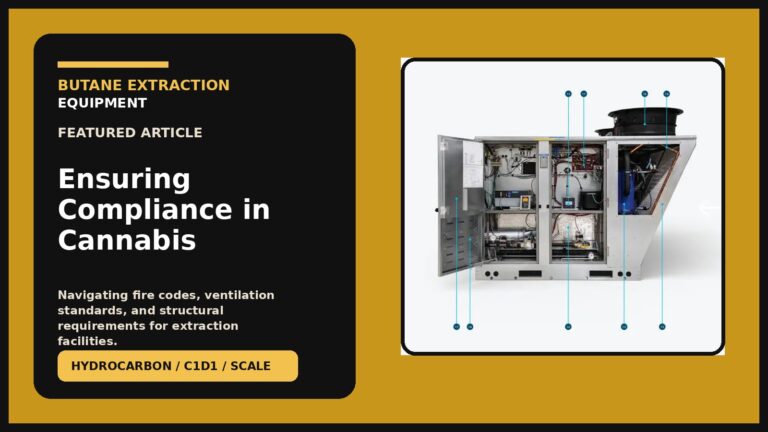
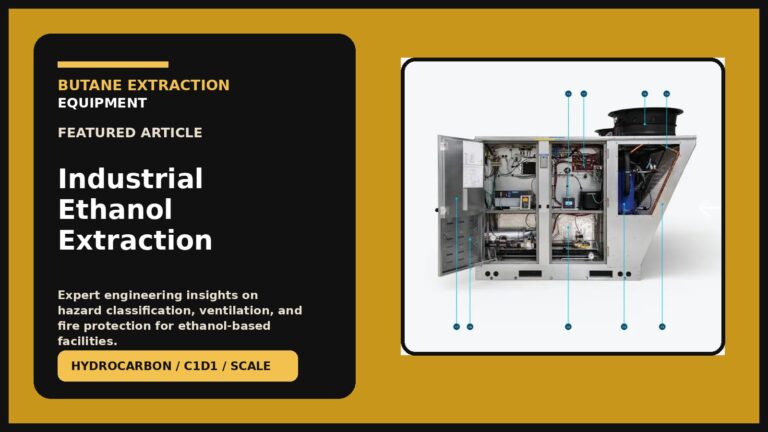
Integrated C1D1 extraction enclosures provide dedicated compliant work zones.
Ventilation and Exhaust Engineering
Given the volatility of ethanol, vapor management is non-negotiable. NFPA 30 (Flammable and Combustible Liquids Code) mandates strict continuous mechanical ventilation protocols for indoor processing areas. System design must ensure that vapors do not accumulate and reach their lower explosive limit (LEL) at any point within the room. This is achieved through engineered exhaust rates—typically continuously exchanging air at a calculated cubic feet per minute (CFM) based on the floor square footage—along with specialized sensor integration.
Integrating continuous LEL monitoring is standard practice for modern industrial control rooms. If sensors detect rising vapor concentrations, they automatically interlock with the facility’s exhaust systems and process equipment. These interlocks are programmed to shut down power to potential ignition sources while simultaneously increasing ventilation rates to purge the environment of hazardous fumes.
Fire Suppression Interlocks
Active fire protection systems must be carefully designed to protect ethanol processing zones. Fire codes generally dictate automatic sprinkler configurations, and in environments handling flammable liquids, specialized design densities under FM Global data sheets or NFPA 13 may be required. The goal is to ensure that the suppression system can manage the specific heat release rates associated with high-volume solvent use.
Beyond standard wet pipe configurations, hazardous areas housing commercial extraction equipment often require highly localized fire extinguishing arrays or interlocked electrical shunt trips. These systems are designed to immediately drop power to the extraction footprint during a thermal event, preventing electrical components from contributing to a fire while the primary suppression system activates.

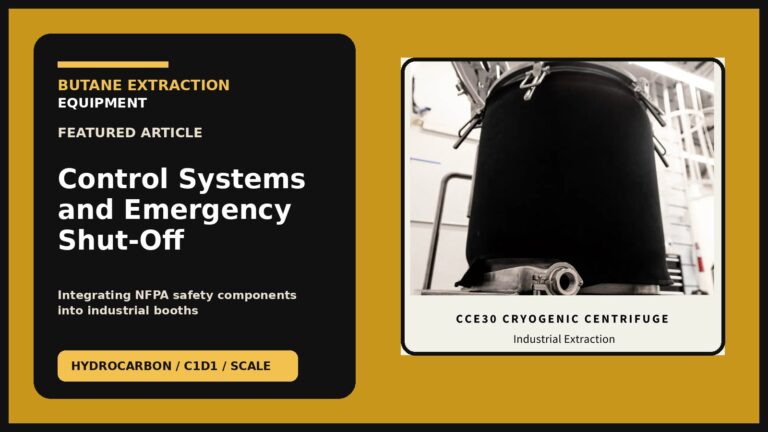
Compliant mechanical ventilation systems mitigating hazardous vapor limits.
Electrical Area Considerations
Due to the risk of ethanol vapor dispersion, equipment and electrical infrastructure installed within the extraction envelope must be intrinsically safe and properly classified. Following NFPA 70 (National Electrical Code), the areas directly adjacent to closed processing systems must utilize Class I, Division 1 or Class I, Division 2 components. This includes properly sealed conduit, explosion-proof motors, and specific luminaire designs that prevent any internal electrical spark from contacting the atmosphere.
Navigating the complexity of electrical classification, vapor mitigation, and occupancy planning requires a cohesive engineering approach to prevent costly redesigns and construction delays. Partnering with experienced fire protection engineers ensures that your extraction space balances optimal industrial throughput with stringent code adherence, creating a sustainable and compliant production environment.