Fire Rated Extraction Booths
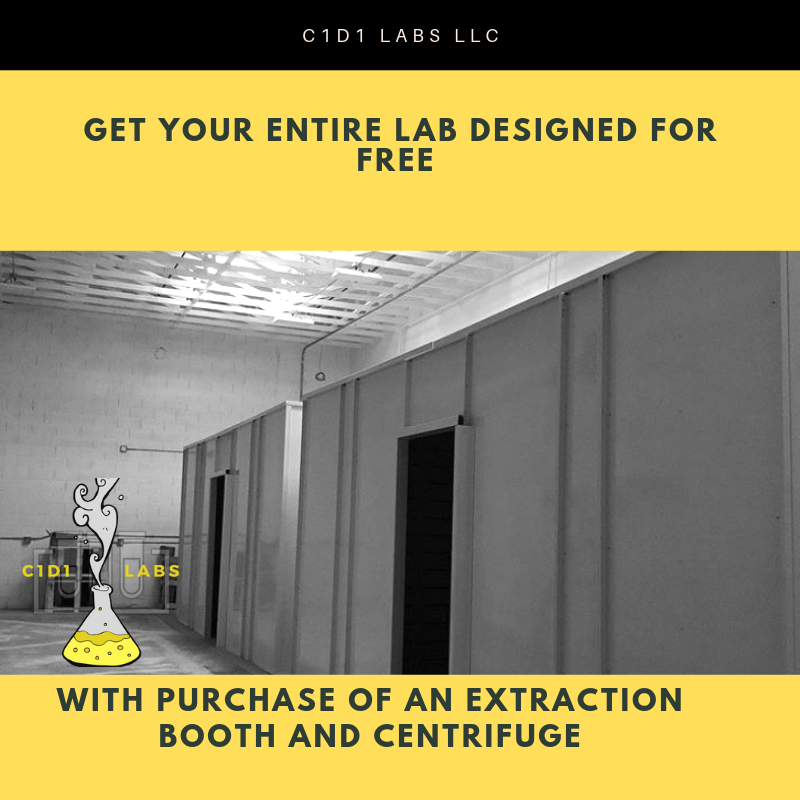
For the first time, C1D1 Labs will now be selling C1D1 / C1D2 Fire Rated Extraciton Booths. We get asked often if having fire rated walls on your extraction booth is necessary and the answer is usually no, unless your local municipality requires this rating. Your standard extraction booth, as long as it is built three feet from any other operation or wall, can be 18 gauge sheet metal
However! Fire rated extraction booths may be your solution to increasing your solvent limits without expensive engineering, labor and materials. Control areas are built when the building area exceeds the maximum allowed quantities of solvent (MAQ). Your MAQs are defined by the building type and a couple characteristics such as fire suppression and solvent storage, for example. A control area is designed to multiply your maximum allowed solvents by separating a chosen area from the rest of the building with fire walls. This separation actually allows you to have multiple ares inside your building that reach the MAQ. A F-1 occupancy building (standard manufacturing building) can have (4) control areas on the first floor of the building, each with it’s own separate maximum allowed quantities of solvent.Therefore, you could potentially have (4) areas with 480 gallons of ethanol, in a F1 occupancy building without having to build any additional fire walls. This is a huge advancement in the extraction booth tech and is patented by C1D1 Labs LLC!
Fire Rated Extraction Booths
If You Build It, They Will Come
Fill out the form below to ask us how to get started. Our C1D1 experts are knowledgeable on extraction rooms, cleanrooms, hydrocarbon closed loop systems, chillers, pumps, and more. Or give us a call
(510) 410-1083
C1D1 Labs Blogs
Giving you the tools and information you need to be successful

C1D1 Booths, Hydrocarbon Extraction Equipment, and Ethanol Extraction Equipment: A Code-Driven Design Strategy
Learn how C1D1 booths, hydrocarbon extraction equipment, and ethanol extraction equipment benefit from code-driven engineering tied to NFPA, IFC, and IBC requirements.

Industrial Fire Hazard Analysis: How PE-Stamped Engineering Lowers Insurance Loss Ratios on Manufacturing Risks
Industrial facilities present some of the most complex risk profiles on any underwriter’s desk. From chemical manufacturing plants to battery production lines and high-throughput warehouses, these properties combine high-value assets, concentrated process hazards, and significant business interruption exposure. Consequently, insurers who rely on generic occupancy classifications often miss the engineered details that drive claim severity. A rigorous industrial fire hazard

How C1D1 Hazardous Area Rooms Power the Battery Manufacturing Boom
Battery plants need hazardous area rooms. C1D1 Labs adapts cannabis extraction expertise to deliver modular C1D1 enclosures, fire protection engineering, and fast permitting for lithium-ion gigafactories.